


Critical Thinking eBook: Decision Frameworks + Brain Teasers

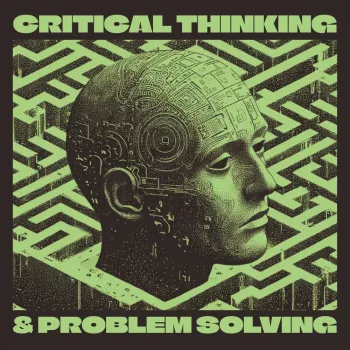
Critical Thinking & Problem Solving eBook: A Practical Digital Guide to Smarter Decisions
Better decisions rarely come from having more information—they come from clearer thinking. This digital download eBook focuses on practical critical thinking habits, structured problem-solving steps, and brain teasers that turn reasoning into a repeatable life skill for work, school, and everyday choices. Instead of relying on “gut feel” or endlessly researching, you’ll practice a simple method for defining the real problem, testing assumptions, comparing trade-offs, and committing to a next step you can defend and improve.
What This eBook Helps Build
- A repeatable process for moving from confusion to clarity
- Tools for spotting weak assumptions, hidden trade-offs, and misleading patterns
- Confidence in decisions under time pressure or uncertainty
- Stronger reasoning through bite-sized exercises and brain teasers
- Transferable life skills: communication, prioritization, and evaluation of evidence
Critical thinking isn’t about sounding smart—it’s about reducing avoidable mistakes. A steady framework helps when the stakes are real: choosing a course schedule, deciding whether to change jobs, planning a project, or troubleshooting why a process keeps failing.
A Simple Framework for Better Decisions
One of the fastest ways to improve outcomes is to treat decisions like a process you can run repeatedly. This eBook organizes decision-making into steps you can do on paper or in a notes app, so you’re not reinventing your approach every time.
- Define the decision: write a one-sentence decision statement and a deadline.
- Clarify the goal: distinguish outcomes (what matters) from preferences (nice-to-have).
- List realistic options: include a “do nothing” baseline to compare against.
- Gather evidence: separate facts, estimates, and opinions; note missing information.
- Test assumptions: ask what must be true for each option to work.
- Compare trade-offs: identify costs, risks, reversibility, and second-order effects.
- Choose and commit: pick the best option for the goal—not the perfect option.
- Review the outcome: capture lessons to improve the next decision.
If you want background on how researchers and philosophers formalize decision-making, Stanford’s overview of decision theory is a helpful reference: Decision Making (Overview).
Common Thinking Traps That Lead to Bad Calls
Even smart people make predictable mistakes—especially when stressed, rushed, or emotionally invested. The eBook highlights common traps and shows how to catch them early, when it’s still cheap to change course.
- Confirmation bias: seeking evidence that supports a preferred answer while ignoring disconfirming facts.
- Availability bias: overweighting recent, vivid, or memorable examples.
- Sunk cost fallacy: continuing because time or money has already been spent.
- Overconfidence: mistaking certainty for accuracy, especially with complex problems.
- Framing effects: changing decisions based on how the same information is presented.
- Correlation vs. causation: assuming one thing caused another without a mechanism or test.
For a credible overview of cognitive biases and why they’re so hard to notice in the moment, see: Cognitive Biases and How to Avoid Them.
Brain Teasers as Training, Not Trivia
Puzzles can be more than entertainment. Used correctly, brain teasers train the same behaviors that improve real-world problem solving: being precise, checking your work, and explaining your reasoning clearly.
- Use puzzles to practice precise definitions, logical steps, and error-checking.
- Focus on process: write the constraints, test edge cases, and explain the reasoning.
- Track improvement: note which mistake types repeat (skipping steps, assuming, misreading).
- Translate the habit to real life: budgeting, negotiations, hiring, studying, and planning.
Over time, the biggest payoff is learning to slow down at the right moments. A 30-second pause to validate assumptions can prevent hours of rework—or an expensive choice you can’t easily reverse.
Quick Practice: From Problem to Plan in 10 Minutes
Decision Drill Template
| Step | Prompt | Example Output |
|---|---|---|
| Define | What exactly needs deciding? | Choose a study plan for the next 2 weeks |
| Goal | What outcome matters most? | Raise exam score by 10% |
| Options | What are 3 viable choices? | Daily 45-min sessions / Weekend deep dives / Tutor + short sessions |
| Assumptions | What must be true? | Time is consistent; materials are available |
| Risks | What could derail it? | Burnout, schedule conflicts |
| Next test | What action gives feedback fast? | Try the plan for 3 days and measure recall |
Who This Digital Guide Fits Best
Digital Download Basics
Featured Picks (In Stock)
- Critical Thinking & Problem Solving eBook – Digital Download Guide for Smarter Decision Making, Brain Teasers & Life Skills Ebook ($27.99)
- Full-Length Floor Mirror with Stand ($222.97) — a simple upgrade for a home office or study space setup.
- Artificial Boxwood Spiral Topiary Plant ($89.17) — low-maintenance decor to make a workspace feel more finished.
Get the Critical Thinking & Problem Solving eBook
If your goal is to make sharper calls with less second-guessing, the Critical Thinking & Problem Solving eBook – Digital Download Guide for Smarter Decision Making, Brain Teasers & Life Skills Ebook is designed to be practical: decision frameworks you can reuse, problem-solving structure that keeps you honest, and brain-teaser practice that strengthens reasoning habits over time. It works as a standalone guide or as a companion to school, professional development, and interview prep.
FAQ
Is this eBook suitable for beginners with no formal logic background?
Yes. The guide is designed to be beginner-friendly, using step-by-step frameworks and approachable exercises. Brain teasers are included as progressive practice, so you can build habits without needing formal logic training.
How long does it take to see improvement in decision-making?
Many people notice clearer thinking within a few days of consistent practice, with more reliable decision habits developing over a few weeks. Short sessions work well—especially when you apply one tool each week to a real decision you’re currently facing.
Can the brain teasers help with real-world problem solving at work or school?
Yes. Brain teasers strengthen transferable skills like identifying constraints, checking assumptions, and communicating a solution step-by-step. Those same habits carry into planning, troubleshooting, studying, and explaining recommendations to others.















Leave a comment