
Labeling Tips to Organize Home, Work & Digital Files

Label Like a Pro: Smart Tips for Organizing Home, Work, and Digital Life
Labeling works best when it reduces friction: less searching, fewer duplicates, and clearer “homes” for things. A good system doesn’t rely on motivation or perfect habits—it relies on simple categories, obvious placement, and wording that matches how people naturally look for items. Use the steps below to build a labeling approach you can keep up long after the first declutter.
What “Good Labels” Actually Do
Labels aren’t decoration; they’re decision shortcuts. When they’re done well, they make daily routines smoother and make it easier for everyone in the space to put things back.
- Make decisions faster: one clear category beats five vague piles.
- Prevent clutter rebound: “Where does this go?” has a visible answer.
- Support shared spaces: consistent rules reduce misunderstandings.
- Reduce duplicate buying: inventory is easy to scan at a glance.
- Work across physical and digital life: the same logic can organize rooms, routines, and files.
That usability angle—effectiveness, efficiency, and satisfaction—is a helpful way to judge your system. If a label set looks great but people still avoid using it, it’s not doing its job. (See usability basics at NIST.)
Start With Categories Before You Touch the Label Maker
The fastest way to waste labels is to label items before you’ve decided on categories. Instead, create a structure that makes sense first, then label what you want repeated.
- Go broad, then narrow: Kitchen → Baking → Pans, and only add subcategories when a bin gets too full.
- Name by purpose when it improves retrieval: “Lunch Prep” is often easier than “Plastic Containers.”
- Avoid permanent “miscellaneous”: use a time-bound “Sort by Friday” bin instead.
- Set container limits: if it doesn’t fit, edit the category or reduce the items.
- Test with a fresh brain: ask where someone else would look first and adjust accordingly.
A practical rule: if you can’t define the category in 1–3 words, it’s probably not ready to label yet.
Choose the Right Label Style for the Job
Different environments destroy different labels. Heat, humidity, friction, and frequent handling all affect what lasts—and what turns into peeling clutter.
Common Label Types and When to Use Them
| Label type | Best for | Pros | Watch-outs |
|---|---|---|---|
| Removable paper labels | Short-term sorting, seasonal bins | Easy to change; low cost | Can peel in humidity; ink may smudge |
| Vinyl/laminated labels | Pantry, cleaning supplies, high-touch bins | Durable; wipeable | Harder to remove; needs smooth surface |
| Clear labels | Minimalist containers, glass jars | Looks clean; blends in | Lower contrast if text is small |
| Color-coded dots/tape | Kid zones, quick ID systems, files | Fast recognition; flexible | Can become confusing without a legend |
| Digital tags (folder names, prefixes) | Files, photos, shared drives | Searchable; scalable | Needs naming rules to prevent duplicates |
Room-by-Room Labeling Plans That Stay Simple
Kitchen
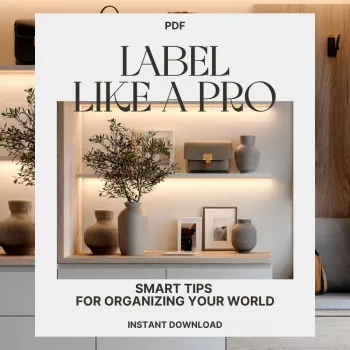
Label by workflow to reduce daily decision fatigue: “Breakfast,” “Snacks,” “Baking,” “Lunch Prep.” If you frequently restock, keep labels at eye level and use large text. If you need a quick refresh for your kitchen zones and supply lists, the Label Like a Pro: Smart Tips for Organizing Your World (Printable eBook) can be used as a repeatable reference while you set up categories.
Closet
Label by use-case to speed routines: “Workwear,” “Gym,” “Weekend,” “Outerwear.” If getting dressed is a bottleneck, place a full-length mirror where the decisions happen; a practical option is the Full-Length Floor Mirror with Stand so outfits can be checked quickly before items get put back.
Bathroom
Kids’ spaces
Pair words with simple icons and keep categories wide enough to maintain: “Blocks,” “Art,” “Dress Up,” “Books.” For shared rooms, labels reduce arguments because the “rules” are visible. If you’re planning a big kid-room reset (including where toys should return at the end of the day), it helps when furniture layout supports easy access; the Twin Over Twin Bunk Bed with Slide and Ladder can open floor space so labeled bins and shelves are easier to reach.
Garage and storage
Digital Labeling: Folders, File Names, and Search-Friendly Structure
Digital clutter feels different, but the fix is similar: consistent names, predictable “homes,” and a simple intake process. For long-term access, it’s also smart to use formats and structures that age well; the Library of Congress digital preservation resources offer practical guidance for keeping files usable over time.
Maintenance Habits: The Part That Makes It Last
Printable Guide Option: A Ready-to-Use Labeling and Decluttering System
When you want quick structure without reinventing categories for every room, a printable reference can keep decisions consistent. The Label Like a Pro: Smart Tips for Organizing Your World | Digital Guide for Labeling, Categorizing & Decluttering | Printable eBook for Home, Work & Digital Organization is designed for quick reference while you organize: categorize first, label second, then set maintenance cues. It’s also useful for digital folders thanks to repeatable naming rules.
FAQ
What should be labeled first when organizing a home?
Start with high-traffic zones that create daily friction: pantry/snacks, cleaning supplies, an entry drop zone, and one “inbox” bin for incoming items. Early wins in these areas make the rest of the system easier to maintain.
How do you create a labeling system that other people will follow?
Use common words, large readable text, and categories based on where people naturally look first. Keep categories limited and place labels where hands and eyes already go (front of bins, eye-level shelves).
What’s a simple file-naming rule for digital organization?
Use a consistent pattern like YYYY-MM Topic v# and add a clear status word when needed (FINAL or SIGNED). This keeps files sortable, searchable, and less likely to be duplicated.















Leave a comment